5 reasons to love copper peptides for your skin.

Fine lines that linger. Skin that feels less firm. A complexion that doesn’t look quite as smooth?

If that sounds familiar, there’s a copper peptide worth getting to know.

Meet GHK-Cu—and the violet cream that makes it a simple part of your day.

  • Understand the ingredient. Why researchers are interested in GHK-Cu.

  • Rich color. Lightweight feel. Get to know the violet cream.

  • Keep your routine simple. One familiar cream step.

Brunette woman with natural freckles against muted purple, with handwritten GHK-Cu, fine lines, skin texture and firmness callouts.
About this image

This image was created using AI to illustrate skincare topics. The person shown is fictional. It does not depict a customer, testimonial or demonstrated product result.

Meet Purpology Copper Peptide1% GHK-Cu • Facial Repair Cream

Wondering if GHK-Cu is right for your skin?

Start with what you’ve noticed and the skincare you already use. Seven questions help you explore how Purpology fits your priorities.

Find my skin match
01

Your GHK Levels Change With Age.

Hand-drawn chart of reported plasma GHK: approximately 200 ng/mL at age 20 and 80 ng/mL at age 60. Lavender bars and a descending dotted arrow show lower reported levels with age; these are not skin measurements.
About this image

This AI-created illustration shows reported plasma GHK levels, not measurements in skin or results from Purpology. The values are approximate background reports. Research source.

Your skin changes as you get older. Collagen declines. Fine lines become more noticeable. Skin loses some of its bounce.

There's another change worth knowing about: naturally occurring GHK levels have been reported to decline with age.

When GHK binds with copper, it forms GHK-Cu – the peptide at the heart of Purpology.

02

Smoother-Looking Skin. Beyond Fine Lines.

Illustrative portrait with natural skin texture and white doodle sketches. Handwriting reads: It’s how your skin feels too.
About this image

This image was created using AI to illustrate skincare topics. The person shown is fictional. It does not depict a customer, testimonial or demonstrated product result.

Fine lines are one part of aging skin.

Texture, firmness, and elasticity matter too.

That's why copper peptides have attracted attention in skincare research. Scientists have explored GHK-Cu's relationship with collagen and the processes that help maintain skin structure.

03

Soft Skin. Zero Greasy Finish.

Illustration of violet cream being applied to a woman’s hand with delicate gold rings on lilac fabric. White handwritten notes read: Soft and hydrating. No oil or greasy after feel.
About this image

This image was created using AI to illustrate skincare topics. The person shown is fictional. It does not depict a customer, testimonial or demonstrated product result.

A beautiful bright purple cream that glides on effortlessly.

Lightweight. Quick to absorb. No oily residue.

Just soft, comfortable skin and a skincare ritual you'll actually look forward to.

04

No 10-Step Routine Required.

Illustration of hands dispensing a small amount of violet cream from a Purpology pump onto a fingertip. White handwriting reads: A small amount. Morning or evening.
About this image

This image was created using AI to illustrate skincare topics. The person shown is fictional. It does not depict a customer, testimonial or demonstrated product result.

Great skincare shouldn't take over your bathroom counter.

Purpology makes it easy to add GHK-Cu to your routine.

One lightweight facial repair cream. Use morning or night. Fits your existing skincare routine.

05

Not All Copper Peptides Are Created Equal.

Close-up of the Purpology bottle with GHK-Cu 1% circled. White handwriting reads: 1% GHK-Cu. Quality guaranteed.
About this image

This product illustration was created using AI. It does not depict a customer testimonial or demonstrated product result.

Not every copper peptide is GHK-Cu.

And not every GHK-Cu cream is made to the same standard.

Purpology Facial Repair Cream contains 1% GHK-Cu. Manufactured in the USA.

Know what's going on your skin. Especially when it comes to peptide creams.

The Science Behind Better-Looking Skin.

Fine lines. Less firmness. Uneven texture.

Here's what happens beneath the surface – and why scientists are studying GHK-Cu.

Collagen Keeps Skin Firm.

Collagen supports the skin from within the dermisSimplified skin cross-section. The thin epidermis lies above the thicker dermis. Interwoven collagen bundles are distributed within the dermis; collagen is not a separate layer. Not to scale. The support behind smooth skin. EpidermisDermisCollagen

Collagen gives skin its structure and firmness. As it declines with age, skin can lose some of its bounce.

Laboratory research has found that GHK-Cu can stimulate collagen production in certain skin-cell models.2

Why it matters: Collagen is one of the foundations of firmer-looking skin.

Your Skin Never Stops Renewing.

Epidermal cells mature and move toward the surfaceSimplified epidermal renewal from bottom to top. New cells in the basal layer are plump with nuclei, cells flatten as they mature, and flattened nucleus-free cells are shed at the surface. Upward arrows show direction, not a measured rate. New skin cells. Every day.Cells shedMove upNew cells

Your skin constantly replaces old cells with new ones.7

GHK-Cu has also been studied in tissue repair and remodeling research.3

Why it matters: Healthy-looking skin depends on ongoing renewal and maintenance.

Skin Changes From Within.

Younger and aging dermal collagen networksSimplified comparison at the same scale. Younger skin has a relatively continuous, organized network of overlapping collagen bundles. Aging skin shows more fragmentation and fewer continuous connections. Educational schematic, not a clinical image or a product outcome. Less support. More visible changes.Younger skinAging skinStrong, organizedcollagen networkFragmentedcollagen andless support

With age, collagen fibers become fragmented and skin's elastic network changes.8

GHK-Cu is being investigated for its relationship with processes involved in skin structure.

Why it matters: Fine lines, texture, and firmness are connected to changes beneath the surface.

Based on published research into GHK-Cu and skin biology. Ingredient research does not establish results for Purpology's finished cream.

Light on skin.Easy to love.

Meet the bright purple cream that feels as good as it looks. Silky, lightweight, and packed with 1% GHK-Cu.

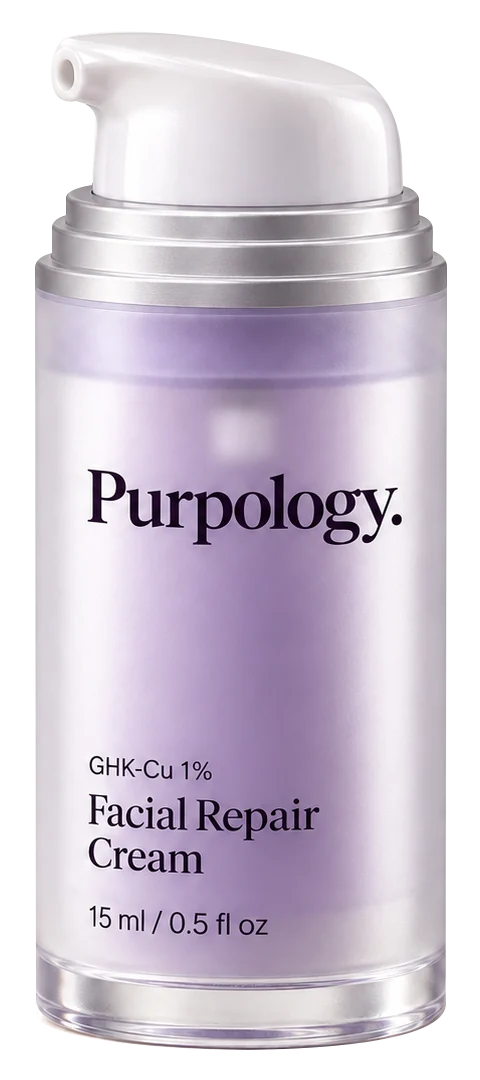
Purpology GHK-Cu 1% Facial Repair Cream, 15 ml airless pump.

Silky, Lightweight Texture

Rich purple cream. Beautifully light on your skin.

Quick Absorption

Glides on smoothly. No waiting around.

No Greasy Residue

Soft, comfortable skin. Never oily or sticky.

1% GHK-Cu

A copper peptide studied for its role in collagen, firmness, and skin renewal.

Purpology GHK-Cu 1% Facial Repair Cream in its lilac 15 ml airless pump.
  • Ammonia-free
  • Sulphate-free
  • PFAS-free
  • Fragrance-free

Ready to try copper peptides?

Purpology Facial Repair Cream

1% GHK-Cu 15 ml / 0.5 fl oz

Rich violet-blue cream with a lightweight feel, quick absorption and no greasy finish.

  • Lightweight
    feel
  • Quick
    absorption
  • No greasy
    finish
Choose your plan

Subscription & one-time purchase terms

Start with one 15 mL bottle for $59 today. Your subscription automatically renews at $79 per month until you cancel.

First month$59today
Then$79/monthuntil you cancel

Save $40 on your first bottle vs. the $99 one-time price.

  • 30-day supply: one 15 mL bottle monthly.
  • Free shipping with every delivery.
  • Change, pause or cancel anytime.

Automatic renewal: after your $59 first month, you’ll be charged $79 monthly until you cancel.

Prefer to buy once? One 15 mL bottle costs $99, with no subscription or recurring charges.

A few things you might be wondering.

Still have a question?
Talk to us.

Can copper peptides actually help with fine lines and wrinkles?

If fine lines are becoming more noticeable, it’s understandable to want more from your skincare. GHK-Cu has shown promise in laboratory research on collagen production in skin cells, which helps explain interest in its potential skin benefits.

Purpology makes 1% GHK-Cu the focus of its Facial Repair Cream. Research on the ingredient doesn’t establish the same results for our finished formula.

Can GHK-Cu help my skin look firmer again?

If your cheeks feel less bouncy or your jawline looks a little different, you’re noticing changes many women recognise. Changes in collagen and elastin are part of that story.

GHK-Cu’s role in collagen-related processes makes it an ingredient worth exploring when firmness is a priority. Evidence for topical products is still developing, and individual results vary. Think support for your skin, rather than a promise to turn back time.

How long before I notice a difference?

It’s natural to want a new cream to earn its place on your shelf. How moisturised and comfortable your skin feels may change before you can judge changes in fine lines, firmness or texture.

There’s no established results timeline for the finished Purpology formula. Use it consistently as directed and pay attention to how your skin responds. Give yourself room to assess it without expecting overnight changes.

I’ve tried expensive anti-aging creams before. What makes Purpology different?

When you’ve spent money on creams that haven’t met your expectations, another big promise isn’t much help. You want to know what you’re buying and where it fits.

Purpology keeps that simple: 1% GHK-Cu in a daily facial cream. A clearly identified copper peptide, in one familiar skincare step. It’s a focused way to explore the ingredient without building a whole new routine around it.

Do I need to change my skincare routine to use Purpology?

You shouldn’t need to start from scratch. Purpology is designed to fit into a daily routine, and your sunscreen still has its place.

Introduce it gradually and follow the directions for each product you use, especially retinol or exfoliating acids. If you use a prescription treatment, ask your prescriber how to fit it in. The aim is a routine you can keep up with, not more steps for their own sake.

What if I don’t love the results?

Finding skincare that suits you can take some trial and error. If Purpology isn’t meeting your expectations, talk to us about your order and how you’re using it.

Prefer to try one bottle first? Choose the one-time purchase option. If you subscribe, you can change, pause or cancel future deliveries anytime.

Research & sources
  1. Pickart, Vasquez-Soltero & Margolina (2017). GHK and age: background reports.

    The introduction reports lower plasma GHK levels in older men, citing earlier literature. This is background evidence, not a study showing that topical skincare restores natural GHK levels, or a measurement of GHK in aging facial skin.

    Brain Sciences, 7:20. DOI: 10.3390/brainsci7020020. Earlier review: DOI 10.1163/156856208784909435.
  2. Maquart et al. (1988). Collagen synthesis in fibroblast cultures.

    GHK-Cu stimulated collagen synthesis in laboratory cultures of skin cells. A cell-culture result does not demonstrate a visible benefit in intact human skin or establish efficacy of Purpology’s finished formula.

    FEBS Letters, 238:343–346. DOI: 10.1016/0014-5793(88)80509-X.
  3. Maquart et al. (1993). Tissue repair in an animal model.

    Researchers administered GHK-Cu in experimental wound chambers in rats and assessed extracellular-matrix components, including collagen. This route of administration and wound setting differ from a daily cosmetic cream used on healthy facial skin.

    Journal of Clinical Investigation, 92:2368–2376. DOI: 10.1172/JCI116842.
  4. Badenhorst et al. (2016). A small topical serum study.

    Thirty-nine women completed an eight-week split-face study of a GHK-Cu serum containing a lipid carrier. Selected wrinkle measurements improved. The control lacked both the peptide and carrier, and the active serum was always used on the right side, limiting what can be attributed to GHK-Cu alone. The tested serum was not Purpology.

    Journal of Aging Science, 4:166. DOI: 10.4172/2329-8847.1000166.
  5. Miller et al. (2006). A small post-procedure study.

    Thirteen patients completed a study of skincare regimens after CO₂ laser resurfacing. Researchers found no significant objective differences in wrinkles or overall skin quality between groups, although subjective improvement favored GHK-Cu. The small, post-procedure population limits generalization.

    Archives of Facial Plastic Surgery, 8:252–259. DOI: 10.1001/archfaci.8.4.252.
  6. Mortazavi et al. (2025; published online 2024). Review of topical GHK research.

    This review discusses biological findings, topical delivery and the limited clinical evidence. It is a review, not a Purpology trial. Formulation and delivery matter when interpreting ingredient research.

    BioImpacts, 15:30071. DOI: 10.34172/bi.30071.
  7. Wang et al. (2018). Natural epidermal renewal.

    Human epidermal observations describe cells moving from the basal layer toward the surface as they differentiate, with surface cells eventually shed. This supports the renewal illustration; it is not evidence that GHK-Cu speeds epidermal turnover.

    Four-dimensional, dynamic mosaicism in normal human skin — PubMed.
  8. Fisher et al. (2008); Quan & Fisher (2015). Skin structure and aging.

    These reviews describe collagen fragmentation and changes in the dermal environment with age. The diagrams show general biology, not measured amounts or a before-and-after treatment result.

    Looking older: fibroblast collapse and therapeutic implications. Age-associated alterations of the dermal extracellular matrix.

Your skin has changed.Find what fits it now.

Answer a few quick questions about your skin and what you’d love to improve. Explore whether GHK-Cu could fit your routine, with a Purpology recommendation based on your answers.

Find my skin match

7 questions · No purchase required

PurpologyQuiz preview
Question 1 of 7

What changes are you noticing in your skin?

Fine lines
Less firmness
Uneven texture
Less-plump skin
Something else? There’s room for that, too.